
Equipotential Bonding
in category: Equipotential Bonding
Chosen
Price
List of products


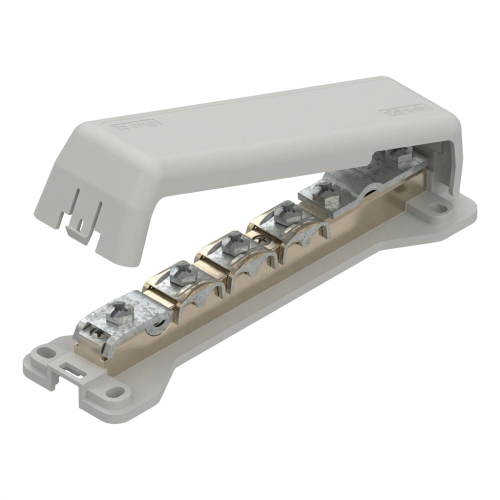
Equipotential bonding for PV frames and lightning protection
Equipotential Bonding covers components that equalise electrical potential in photovoltaic and lightning protection installations. The range includes two stainless steel earthing plates for PV module frames and one nickel-plated brass bonding bar for several conductors. It is intended for installers and builders working on PV systems, residential buildings and commercial premises.
What you will find in this category
- Earthing washer, PV contact plate (PV-20): A2 stainless steel 1.4301 (304), 40×40 mm, 0.2 mm thick, Ø9 mm hole, 8 conical prongs.
- Ω-type earthing plate (PV-20-02): A2 stainless steel 1.4301 (304), 40×42×6 mm, 8 mm hole, screw fixing to module frames and mounting rails.
- Equipotential busbar (000-177): nickel-plated brass, connections for 7x 25 mm², a flat conductor up to 30 mm and a rod Ø 8–10 mm.
How to choose
- Connection point: use the plates to bond PV module frames to the mounting structure. Use the busbar to join several conductors at one point.
- Material: the plates are A2 stainless steel (1.4301, grade 304). The busbar is nickel-plated brass.
- Fixing size: check the mounting hole against your fastener. The washer has a Ø9 mm hole, and the Ω-type plate has an 8 mm hole.
- Plate shape: the washer is 40×40 mm and flat, with a 10 mm bend. The Ω-type plate is 40×42×6 mm and screws to frames and rails.
- Conductor types: the busbar takes seven 25 mm² conductors, one flat conductor up to 30 mm and one round conductor Ø 8–10 mm.
Typical applications
The earthing plates are used in photovoltaic installations. Their prongs or teeth pierce the anodised layer of the module frame, which acts as an insulator, and reach the aluminium beneath. This gives an electrical connection between frames, rails and the supporting structure. The busbar serves as a bonding point in lightning protection and earthing installations in residential and commercial buildings.
Frequently asked questions
Why do the PV earthing plates have prongs or teeth?
The anodised layer on PV module frames acts as an insulator. The prongs or teeth pierce it and reach the metallic aluminium beneath, which gives a reliable electrical connection.
What can be connected to the equipotential busbar?
It accommodates seven 25 mm² conductors, one flat conductor up to 30 mm wide and one round conductor with a diameter of 8–10 mm. It is made of nickel-plated brass.
Not sure which bonding component suits your installation? Contact our technical support for help with selection.