
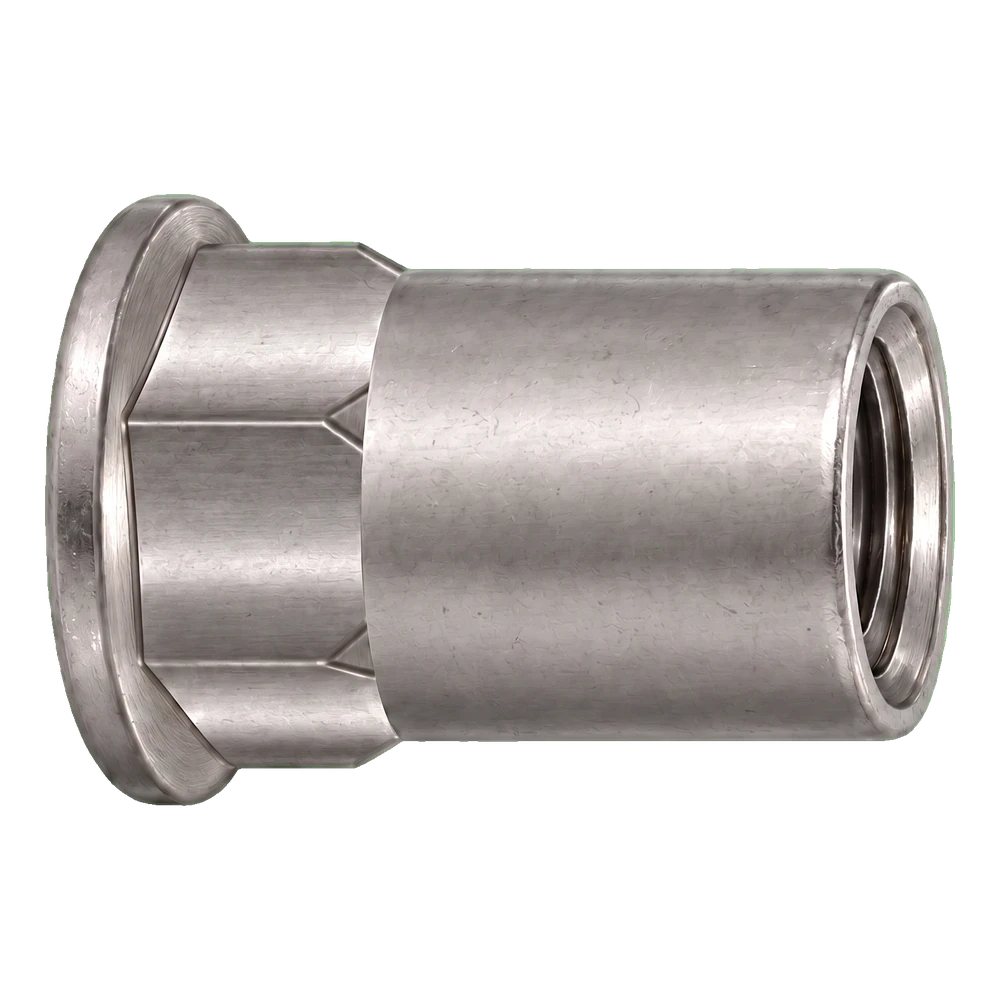
A2 stainless steel rivet nut M6×15.5 mm – flat head, partial hex shank – box of 250 pcs
Leave feedback on the product

Rivet nut in A2 stainless steel, flat head, open-end, part-hexagonal shank. M6 thread, 15.5 mm length, 9 mm flange diameter. Grip range 0.5–3.0 mm. Pack of 250 pcs.
Product code: 002-168
Product features
[PIM] nitonakretki #1015
- Material A2 - stainless steel
- Thread type M6
- Grip range [mm] 0,5–3,0
- Head type flat
- Quantity per pack [pcs] 250
- Shank partial hexagon
Description
Flat head, partial hexagon shank, open-end design, A2 stainless steel

About the product
A rivet nut creates an internal M6 thread in thin sheet metal or a profile when there is access from one side only. It is inserted into the hole and set with a rivet nut tool: the tool engages the thread and pulls it towards itself, while the part of the shank behind the material deforms into a collar that clamps the material together with the head. Once the tool is removed, a ready-to-use M6 thread remains in the material. This model has a flat head with a diameter of 12.3 mm and a height of 1.5 mm, and a partial hexagon shank. The flat head stands proud of the material surface by the head height k. The hexagon part of the shank limits the rivet nut from turning in the hole.
Choose the rivet nut to suit the thickness of the material in which it will be set. The M6 × 15.5 mm rivet nut is intended for material with a thickness from 0.5 to 3.0 mm; for a different thickness, choose another size from the list of nearest sizes. The hole must be hexagonal, measuring 9.1 mm across flats, which is 0.1 mm larger than the shank's SW9. It is best made with a punch – in a round hole, the rivet nut is not secured against spinning.
The rivet nut is made of A2 stainless steel. Where chlorides are present, for example by the sea or a swimming pool, choose the material according to the exposure conditions and the design recommendations. According to the manufacturer's data sheet, it withstands a shear force of 4 700 N and a tensile force of 21 570 N. These are test results for the rivet nut itself – the load capacity of the joint depends on the material and thickness of the element and is set by the design. Sold in boxes of 250 pcs; each box weighs 1.08 kg.
Preparing the installation
- ✓Check the material thickness: it must be within 0.5–3.0 mm.
- ✓Make a hexagonal hole 9.1 mm across flats (shank SW9 + 0.1 mm), preferably punched – in a round hole the rivet nut is not secured against spinning; remove burrs.
- ✓Set with a rivet nut tool with a M6 nosepiece; the head should sit against the surface.
Important
The grip range applies to the total material thickness under the head. The flat head stands proud of the material surface by the head height k. The hexagon part of the shank limits the rivet nut from turning in the hole. The load capacity of the joint depends on the material and thickness of the element – it is set by the design.
Reviews
If you've added a review and it doesn't appear on the list, it may be pending moderation.
Leave feedback on the product
